There is a version of digital marketing that feels like throwing money into the wind. You run a few ads, maybe update your website every few years, and hope something sticks. If that sounds familiar, you are not alone. Most businesses we speak with have tried pieces of a strategy without ever pulling them together into something cohesive. The result is wasted budget, inconsistent messaging, and growth that stalls out right when it should be accelerating.
The businesses that consistently outperform their competitors are not necessarily spending more. They are building around a proven digital marketing strategy framework that connects every channel, every campaign, and every dollar of ad spend into a unified system. At Exposure Media, that is exactly how we approach every client engagement — starting from a clear framework and building from there.
What a Digital Marketing Strategy Framework Actually Is
A framework is not a checklist. It is not a list of tactics you execute one by one and hope they add up to something. A true digital marketing strategy framework is the architecture that determines how all of your marketing activities relate to each other, support each other, and ultimately drive business results.
Think of it as the difference between having a collection of tools and having a workshop. The tools only become productive when you understand how to use them together, in the right order, for the right job. That is what separates businesses growing predictably from those that feel stuck despite spending on marketing.
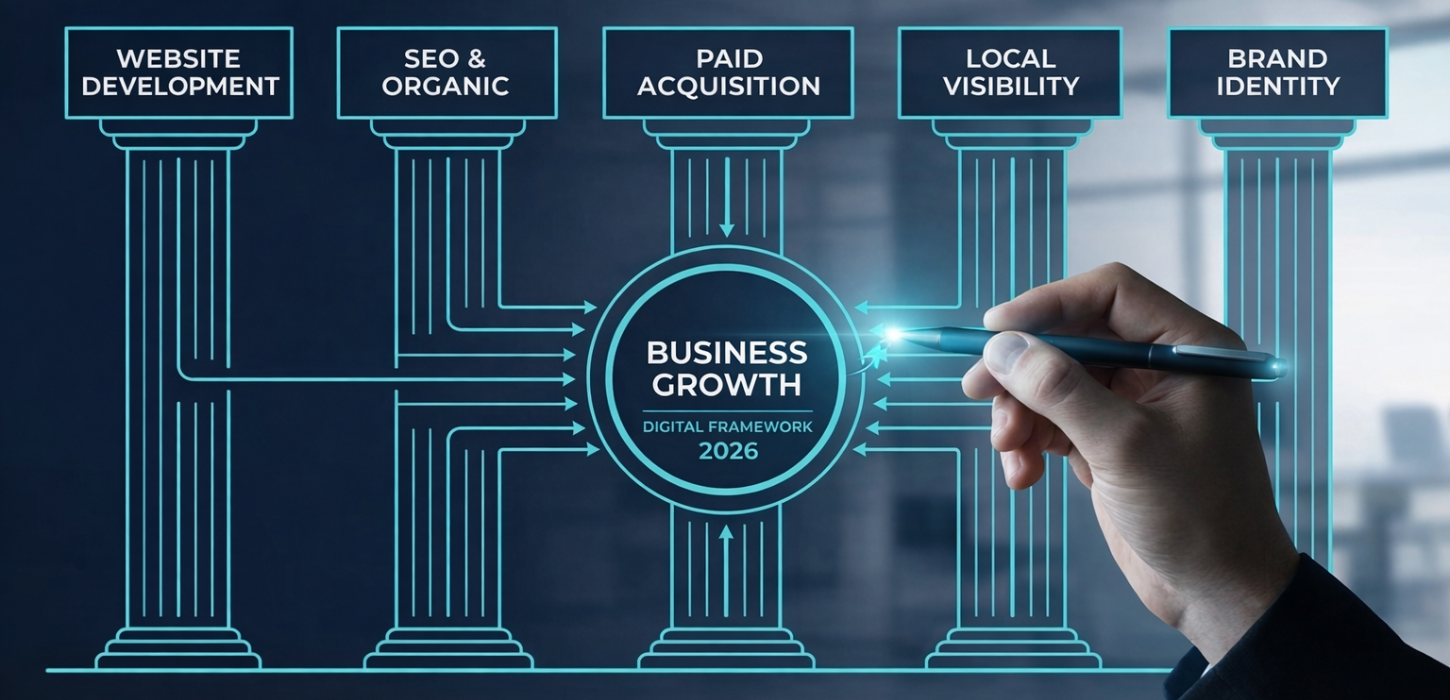
The Five Pillars of a High-Performing Digital Marketing Framework
1. A Conversion-Ready Foundation: Your Website
Everything you do in digital marketing eventually sends someone somewhere. That destination is almost always your website. If your site is slow, confusing, or outdated, every campaign you run is working against itself.
A strong web design strategy ensures that the moment a potential customer lands on your site, they understand who you are, what you offer, and what to do next. This means clean layouts, fast load times, compelling calls to action, and mobile responsiveness. Web development goes a step further — ensuring the backend infrastructure supports the performance and scalability your campaigns demand.
We have seen businesses invest significantly in paid traffic only to watch it disappear because the website experience could not hold attention. A conversion-ready website is not optional. It is the foundation the entire framework rests on.
2. Organic Visibility: SEO That Compounds Over Time
Search engine optimization is the long play, and it rewards businesses that commit to it. Every piece of content, every technical improvement, every backlink you earn compounds over time into authority that paid channels simply cannot replicate.
Our SEO services are built around three core areas: on-page optimization, technical health, and authority building. On-page work means your content targets the right keywords and communicates clearly to both search engines and real people. Technical SEO ensures search engines can crawl and index your site without friction. Authority building, through quality backlinks, signals to Google that your business is trustworthy and relevant.
The businesses that invested in SEO three years ago are now benefiting from organic traffic that costs them nothing per click. The best time to start was then. The second best time is now.
3. Paid Acquisition: Getting in Front of Buyers at the Right Moment
SEO takes time to build momentum. Paid advertising fills the gap and, when done well, delivers qualified traffic from day one. The key word there is qualified. Clicks that do not convert are not a bargain at any price.
A well-structured digital marketing strategy framework uses paid channels strategically rather than speculatively. Google Ads captures intent — people who are already searching for what you offer. Meta Ads on Facebook and Instagram build awareness and create demand among audiences who match your ideal customer profile. Google Local Service Ads are particularly effective for service-based businesses, charging only when a real lead comes through rather than for every click.
Our PPC management approach ties these platforms together under one strategy — aligning targeting, creative, bidding, and measurement so that every dollar has a clear job to do.
4. Local Presence: Being Found Where Decisions Are Made
For businesses serving a specific geography, local visibility is not a nice-to-have. It is often where the highest-intent customers find you. Most people searching for a service provider are ready to hire. They are comparing their options right now, and if your business is not visible in that moment, you do not exist in their decision process.
Local business listings management ensures your name, address, and phone number are accurate and consistent across every directory, map, and platform where customers might look. Your Google Business Profile is optimized to appear prominently in local search results. Reviews are actively managed to build the kind of credibility that makes a new customer feel confident reaching out.
This layer of the framework works quietly in the background, but its absence is felt immediately.
5. Brand Identity: The Coherence That Makes Everything Work Harder
Here is something most businesses underestimate: every element of your marketing works harder when it sits inside a strong, consistent brand identity. Your ads resonate more. Your website builds trust faster. Your content gets remembered rather than scrolled past.
Branding is more than a logo. It is the visual system, the tone of voice, the messaging architecture that tells your audience who you are and why you are different. When your brand is cohesive across your website, ads, social profiles, and marketing materials, every touchpoint reinforces the same impression. That cumulative effect is what separates a business that feels established from one that feels scattered.

Why Most Businesses Struggle Without a Framework
The most common pattern we see is channel-by-channel thinking. A business decides to run Google Ads because a competitor seems to be doing well. They try SEO for a few months, do not see results fast enough, and move on. They get a new website that looks great but was not built with conversion or SEO in mind.
Each of these decisions makes sense in isolation. Together, they produce a marketing effort that never quite adds up to growth. A genuine digital marketing strategy framework solves this by treating every channel as a component of a system rather than a standalone experiment.
Our process begins with a free consultation to understand your goals and current situation. From there, our strategy and discovery phase produces a tailored plan built around where your business actually is and where you are trying to go. We do not believe in one-size-fits-all solutions. The framework is universal; the implementation is specific to you.
Frequently Asked Questions
How long does it take to see results from a digital marketing strategy?
It depends on the channel. Paid advertising through Google or Meta can generate leads within the first week of a campaign launch. SEO typically takes three to six months before meaningful organic traffic growth is visible, though the foundation work begins paying dividends earlier. A comprehensive framework uses both paid and organic channels so you are generating results now while building long-term assets simultaneously.
What is the difference between SEO and PPC, and do I need both?
SEO (Search Engine Optimization) earns organic rankings over time through content quality, technical performance, and authority. PPC (Pay-Per-Click) buys placement in search results or social feeds and delivers traffic immediately. They serve different roles in a marketing framework. Most businesses benefit from running both in parallel because each covers a weakness the other has: PPC fills the visibility gap while SEO is building, and SEO provides cost-effective traffic as paid costs compound over time.
How do I know if my current website is hurting my marketing performance?
Key signals include high bounce rates, low conversion rates on landing pages, slow page load speeds (anything over three seconds), and poor rankings in search results. If your site is not mobile-responsive or is more than three to four years old, it may not meet current technical standards. A website audit can identify specific issues and quantify the impact they are having on your results.
What makes Google Local Service Ads different from standard Google Ads?
Google Local Service Ads appear above standard search results and only charge when a potential customer contacts your business directly, whether by call or message. They also feature the Google Guaranteed badge, which adds credibility and typically increases click-through rates compared to traditional ads. For local service businesses, LSAs are often the most cost-efficient paid channel available.
How important is brand consistency across digital marketing channels?
Highly important. Research consistently shows that consistent brand presentation increases revenue compared to inconsistent presentation. When customers see the same visual identity, messaging, and tone across your website, social ads, and search results, it builds recognition and trust faster. Inconsistency creates cognitive friction that can undermine even strong offers and well-targeted campaigns.
Building the Framework That Grows Your Business
A digital marketing strategy framework is not something you buy once and leave running. It is something you build deliberately, optimize continuously, and expand as your business grows. The components covered here — a strong website, organic search presence, paid acquisition, local visibility, and brand identity — form an interconnected system where each element strengthens the others.
At Exposure Media, we have built this framework for businesses across industries, and we do it without long-term contracts or opaque reporting. You get full transparency into what we are doing, why we are doing it, and what results it is producing. Our month-to-month model keeps us accountable in a way that annual contracts simply do not.
If your current marketing feels like it is working hard without delivering proportionate results, the issue is almost certainly the absence of a coordinated framework. We can help you identify the gaps and build a strategy around your specific goals and market.
Contact Exposure Media today for a free consultation and see what a structured, results-driven approach to digital marketing looks like in practice.